Cautiously optimistic but I'm always wary of unions that get the corporations blessing. We have some like that in Australia (SDA stands out as I used to be a member) and they can be incredibly toothless at times. But that being said, I would rather be in a weaker union than no union at all.
Unionisation like this is always a positive for the workers and I hope it brings about positive changes for all of Ubers drivers and leads to further unionisation efforts in the ride sharing market around the globe. If you're an uber driver in the UK get active and push for the improvements you need, and if you're an uber driver around the world start organising!
In France we call those "yellow unions", as opposed to "red unions" which are more adversarial with the company.
The most notable yellow union is CFDT, which is one of the largest cross-sector unions in the country. A saying I heard once was "Management could establish slavery, and CFDT would negotiate the weight of the chains".
Natural selection. Red unions make companies go bankrupt, and relocate outside of France. Btw unions are mandatory in France above 50 employees. Which is why you find an awful lot of companies with 49 employees in France.
Just because they have a good relationship with the management doesn't mean they're toothless. Some employees don't want to be threatening a strike every week.
But yeah, people who identify with the more militant unions kind of despise the CFDT types.
The GMB is one of the UK's largest trade unions. If they don't have teeth, nobody does, so I'm more than cautiously optimistic. This is excellent news.
Not OP but SDA union is - by numbers - one of the largest unions in Australia but is not well known for protecting its members (mostly retail workers).
Possibly. Either way they dont seem very effective compared to the previous decade, or, say, Unite.
Supporting Owen Smith (an anodyne career politician who is now a PR flack) in the Labour leadership election in what looks like a rigged vote isn't indicative of a pro worker outlook, either:
In the U.S., workers are entitled to choose union representation by filing a petition with the National Labor Relations Board. If the employer refuses to recognize the union on the basis of a majority showing of interest, the NLRB will schedule an election. If the majority of workers vote for the union, it is certified, and the employer is legally obligated to bargain. Virtually every democracy has some mechanism for certifying unions on the basis of majority support.
The point is that the process the person you’re responding to is saying also applies if the company is not willing to work with the union. You did ask how else a union would organize without being blessed by corporate as this one is.
Uber has only very limited control over which union gets to represent workers (not in the UK anyway), so if toothless unions ends up representing people, that is because those are the unions their workers choose.
Although any union is able to represent members at any workplace, it's worth noting that this does affect future claims for recognition (and so collective bargaining rights) for other unions. In particular, if an employer refuses to recognise a union they have a right to apply for 'statutory recognition' through the Central Arbitration Committee - but this can only succeed if there is no other recognised union for that bargaining unit[0].
The GMB are a large, well-established, general union. It wouldn't surprise me if Uber were much keener on having them as the sole recognised union than, say, the Independent Workers' Union of Great Britain[1] - who are also organising Uber workers and are smaller, scrappier, and more militant than the GMB.
What if I want to work just for a few hours on a Friday night and that's it? What if I want to directly interface with Uber without anyone being above me (the union in this case)?
More power is stripped from me in this case as it always happens; Union = less freedom for an individual.
The union's power comes from turning individual workers into a group. In order to have collective bargaining power, inidividuals will have to sacrifice some of their freedoms. This is not a problem if all employees want the same things. For example, unions can demand higher pay and better hours because no individual worker will accept working in worse conditions. In this case, the workers sacrifice the freedom to accept a job that isn't up to standard. If there are no other workers available to supply the corporation's demand, it is forced to raise pay and lower hours.
I would argue having zero leverage against rich corporations is always worse than sacrificing a few freedoms. In some cases though workers don't actually agree on what they want. This means the workers are not actually united in their cause and the union of course breaks down.
If I want to work for Uber given their conditions, who has the right to tell me I can't? Who has the right to tell me I must obey by some group's rules first (the union in this case)? It's bizarre.
I am all for unions. Go and organize people. But unions can't have special privileges granted by politicians (who very often are just bribed by those that run the union), and unions must never be mandatory to join. Mandate to join an union is immoral.
> Who has the right to tell me I must obey by some group's rules first (the union in this case)?
In principle, no one. The whole idea of a union is everyone wants the same thing and will refuse to work if these wants are not met. If people want different things, the union doesn't actually exist.
> But unions can't have special privileges granted by politicians, and unions must never be mandatory to join.
> Mandate to join an union is immoral.
I agree in principle but in practice things get ugly fast. For example, developed countries have immigrant workers whose legal presence in the country is conditional on their continued employment. Corporations have a huge amount of leverage against these workers and will probably exploit them. Their ability to exploit these people leads to significantly diminished power of unions. I just have no idea how they're supposed to solve this issue in a way that keeps these principles intact.
Good point. However, those immigrants wouldn't be in a country if it wasn't better than the alternative - which is their country. Of course it's not always the case, sometimes they are forced to which is fucking horrible.
The exploitation of people is obviously wrong but I suspect the unions is not the answer.
Yeah, it sucks. The market is ruthless in exploiting economic disparities. For example, right now 1 USD is valued at 5.31 BRL. A salary of $20k/year is a ridiculous amount of money in my country. It's more than what the vast majority of people make working here. If corporations can exploit something like this, they can effectively reduce the value of their american workers.
The solution in this case is to somehow make companies ignore these economic opportunities. Make them pay immigrants the same salary they'd pay a worker from their own country.
The people harmed by the externalities of your personal choices because you live in a society where some degree of cooperation with the larger community is required.
The wage effect of the personal choice of what wage to work at it is not an externality. An externality is when one party's actions deprive you of something you are entitled to, like your person or property. The opportunity offered by another individual, is not yours to begin with, and that other indivual has a right to withdraw it by contracting with someone else at a lower wage.
By way of analogy, imagine if you training to become physically more attractive made other male suitors less attractive to women in general. You did not, by virtue of making yourself more attractive, impose a negative externality on other men, as they were never entitled the affection and engagement of women in the first place.
Moreover, the absence of labor regulations and social democratic policies is associated with more rapid economic growth and larger wage gains, so the premise of the notion that there are negative externalities emanating from contract liberty is wrong. The free market is far and away the most efficient way to organize an economy, because the market is the ultimate coordinating tool, and helps raise productivity, which has enormous positive externalities.
These sound like the fundamentalist tenets of an ideology, that just happen to further the interests of the rich, but the statistical/empirical evidence has constistently validated these assertions, as do rationalist deductions based on game theory and widely accepted economic axioms like supply and demand and the efficiency of equilibriums established by them.
> The free market is far and away the most efficient way to organize an economy,
By 'free' do you mean unregulated?
And efficiency (which you seem to equate with 'return on capital') isn't the only positive value, nor is efficiency necessarily a good proxy for all other positive values.
In any case, while a theoretical perfect market without any asymmetries might be most efficient, in practice we have markets that are imperfect in many ways that induce market failures, and regulation is needed to compensate and restore market efficiency. The market for labor is no exception, as the asymmetries in labor relations are huge.
>>And efficiency (which you seem to equate with 'return on capital') isn't the only positive value, nor is efficiency necessarily a good proxy for all other positive values
Efficiency is the only thing that matters. Take two countries: Pragmatia and Utopitia. Pragmatia solely pursues efficiency, in line with its pragmatic ideals, while Utopitia pursues social democratic ideals, in line with its utopianist ideals.
Pragmatia consequently sees GDP grow at an annual rate of 5% a year, while Utopitia sees its GDP grow at 2.5% a year.
From a starting point as equals in 2022, Pragmatia acquires a 3 to 1 per capita GDP advantage over Utopitia within 50 years, providing Pragmatia's residents with a vastly better standard of living than Utopitia's, irrespective of how large of a percentage of the latter's GDP was expropriated by the state for social democratic redistribution.
This was basically the story of Hong Kong vs Mainland China from the 1950s to 1980:
>>In any case, while a theoretical perfect market without any asymmetries might be most efficient, in practice we have markets that are imperfect in many ways that induce market failures, and regulation is needed to compensate and restore market efficiency.
Imperfect markets don't imply that wages are below what they would be under free market conditions, or that a crude intervention, like granting labor unions with collective bargaining monopolies over companies' hiring practices will counter-act the wage-inhibiting effect of some market inefficiency, let alone do so without introducing far larger and more significant inefficiencies of its own.
Basic supply and demand theory tells us that the employment standard mandates, like minimum wage controls, advocated by unions, to the extent that they have an effect, harm economic efficiency. In the absence of the ability to conduct controlled experiments to prove definitively its effect one way or another, we should opt to trust basic economy theory.
>>The market for labor is no exception, as the asymmetries in labor relations are huge.
Asymmetries are irrelevant. Apple is worth over $2 trillion, yet cannot force me to buy a Macbook Pro. It can only induce me to do so by offering more value than competitors.
If we let Apple and its social justice PR firms convince us that we need the government to control the consumer electronic market, then Apple could, through regulatory barriers, keep competitors out, or through taxation, force us to indirectly buy its products, by funding the state that does.
>>And efficiency (which you seem to equate with 'return on capital') isn't the only positive value, nor is efficiency necessarily a good proxy for all other positive values
Efficiency is the only thing that matters. Take two countries: Pragmatia and Utopitia. Pragmatia solely pursues efficiency, in line with its pragmatic ideals, while Utopitia pursues social democratic ideals, in line with its utopianist ideals.
Pragmatia consequently sees GDP grow at an annual rate of 5% a year, while Utopitia sees its GDP grow at 2.5% a year.
From a starting point as equals in 2022, Pragmatia acquires a 3 to 1 per capita GDP advantage over Utopitia within 50 years, providing Pragmatia's residents with a vastly better standard of living than Utopitia's, irrespective of how large of a percentage of the latter's GDP was expropriated by the state for social democratic redistribution.
This was basically the story of Hong Kong vs Mainland China from the 1950s to 1980:
>>In any case, while a theoretical perfect market without any asymmetries might be most efficient, in practice we have markets that are imperfect in many ways that induce market failures, and regulation is needed to compensate and restore market efficiency.
Imperfect markets don't imply that wages are below what they would be under free market conditions, or that a crude intervention, like granting labor unions with collective bargaining monopolies over companies' hiring practices will counter-act the wage-inhibiting effect of some market inefficiency, let alone do so without introducing far larger and more significant inefficiencies of its own.
Basic supply and demand theory tells us that the employment standard mandates, like minimum wage controls, advocated by unions, to the extent that they have an effect, harm economic inefficiency. In the absence of the ability to conduct controlled experiments to prove definitively its effect one way or another, we should opt to trust basic economy theory.
>>The market for labor is no exception, as the asymmetries in labor relations are huge.
Asymmetries are irrelevant. Apple is worth over $2 trillion, yet cannot force me to buy an Mac Pro. It can only induce me to do so by offering more value than competitors.
If we let Apple and its social justice PR firms convince us that we need the government to control the consumer electronic market, then Apple could, through regulatory barriers, keep competitors, or through taxation, force us to indirectly buy its products, by funding the state that does.
Corporations are just legal agreements. There is no need for the state to be involved for them to exist, though of course it helps the formation and preservation of corporations that a state exists to enforce contract law and protect the right to person/property, but that equally applies to any legal agreement.
The only extra-contractual benefit the state grants corporations is limited liability for tort.
Yes, technically you don't have to join unions anywhere in the US. If you want, you can give up your membership and benefits, but still have to pay dues. Obviously, that's really one-sided, which is why a few states (but not the whole US) have passed right-to-work laws.
Federal law forces US unions to represent non members. "Right to work" laws force unions to do it for free in most states. The rest allow unions to charge agency fees to cover the mandated services. Not full dues.
this is a pretty textbook definition of unions, which has little parallel with what unions do: they use collective bargain power to obtain more power for themselves, with some breadcrumbs falling down to the actual workers.
works like this: it's all fun and games until the union can get to the point where union participation becomes mandatory for joining the sector/company. after participation is no longer optional, workers essentially end up feeding two owners, with unions demanding higher fees, red tapes requiring more union mandated bureaucrats, while promises to workers get delayed or forgotten
I'm all for unions, but there's some truth in being skeptical and attentive around them. if requirement for mandatory union fees and automatic union participation for sectors could be outright outlawed, I'd be much more optimistic, but these aren't and I don't.
Absolutely. I don't like mandatory unions either. If all workers don't actually want the same thing, the union doesn't actually exist in the first place. In principle we shouldn't force it into existence by making them mandatory.
>>I would argue having zero leverage against rich corporations is always worse than sacrificing a few freedoms.
It is not. If you are looking for a job, and a union has monopolized all of a corporation's positions and imposed restrictive employment rules constraining who the corporation can hire, it reduces your leverage in negotiating to gain a position, by making it harder for you to offer a compelling deal to the corporation.
You can't offer to work for below the minimum wage, or to forego some benefit, for example.
Unions only appear to help workers if you look at it superficially.
Isn't it kinda weird that every single large company moves aggressively to crush labor unions if they are so bad for the individual worker? I keep seeing this perspective and it is baffling to me.
IMO, some unions are bad for everyone. Worker and company alike.
Most (maybe all?) unions are meant to oppose the company. Their stated goal is get more for the workers, which means less for the company.
But to be fair, some unions actually end up helping companies that can't understand that treating your workers well actually has benefits for the company, too, and if you treat them too poorly, there will be a net detriment to the company. These unions actually help everyone, but it requires that the company really have their head up their ass.
So it's not surprising to me that every single company fights the union. The whole point of the union is to fight the company on behalf of the workers.
> But to be fair, some unions actually end up helping companies...
When I was in college I worked for a roofing company where there actually seemed to be a pretty healthy relationship between the local unions and the companies employing their members. The unions ran a great apprenticeship program, were super strict on safety, and seemed to have a reputation in the area for doing good work. This meant that companies had a good idea what they were getting when they paid the premium for a journeyman. My impression was that being a "union shop" was a differentiator for businesses and that there were plenty of customers that were willing to pay more for the confidence that things would be done right.
Of course the common complaint for a situation like this is that you end up with journeymen who abuse their position and don't meet the standards they are supposed to, but I didn't seem much of this. I got the impression that the union did a pretty good job of keeping their members in line, especially when it came to safety infractions.
It's a shame that this doesn't seem to be more common. It was an amazing program since if you could land an apprenticeship (and they were desperate for people) you could theoretically climb the ladder from poverty to the middle class in 5 years.
Isn’t it kinda weird that so many parents move aggressively to prevent their kids from eating candy for dinner if it makes them sick?
> I keep seeing this perspective and it is baffling to me.
It’s baffling to you because you haven’t considered that many companies have good relationships with employees and are interested in that relationship staying non-adversarial.
Companies want to keep workers non-adversarial. They give themselves the right to be as adversarial as they want. They're likely to be extremely adversarial against workers who want a raise in pay, better hours, better working conditions, generally anything that would reduce their profits in any way.
> They're likely to be extremely adversarial against workers who want a raise in pay, better hours, better working conditions, generally anything that would reduce their profits in any way.
This wasn’t true in literally every business I’ve worked for.
If you expect someone to behave adversarially and you act in kind (forming unions), then you’ve already poisoned the relationship.
Perhaps it’s different because I’ve been in highly skilled labor pools but you’re setting yourself up for a life of bare minimums and limited advancement if you assume every business relationship you go into is adversarial.
The relationship between employer and employee is innately adversarial. Employer decides conditions of employment and pay, employee decides whether to keep working or not. It's a huge power imbalance.
No it’s not. You literally just quit and move on. This is one of the easiest environments to find a job in if you have a decent resume of actually working somewhere for more than a few months.
The company you work for is not your parent, and in fact, the history of labor/managerial relationships in the US demonstrates pretty unequivocally that your company doesn't have your best interests in mind.
Listen to Milton Friedman. He explains this (and many more questions regarding the economy) extremely well. Begin with this video: https://www.youtube.com/watch?v=xzYgiOC9cj4 (The Real World Effects Of Unions)
Unions are generally good if your living situation, and needs generally mirror the majority of your co-workers.
However if you have unique needs, or desires then your needs will take a back seat over the "majority"
In modern society we seem to have a majoritarian view of everything, and are losing individualism.
An example of this is the often advocated for Maternity / Paternity leave, this is something that is often fought for by unions as the majority of employees need / desire that leave. However if you are someone that do not intention of ever having children then you may prefer more Vacation time, or more PTO time, or greater health benefits in some other arena, your desires however will be ignored because the Majority wants the Maternity / Paternity leave
This is such a common myth that ignores that industries with absolutely extreme variations in skill and compensation between individual workers work quite well with unions, like the entertainment and professional sports unions.
It does not ignore it, because those "unions" are not the type of unions people generally talk about in the US when they talk about Employment Unions, and would not be the unions employed in the US for Uber which would most certainly be a Closed Shop and not allow for the range of individualized labor deals you are talking about when it comes to unions for Entertainment and Sports, those unions are the EXCEPTION not the rule when it comes to Labor Unions in the US
Showing that there exists an example situation where a union reduces your freedom does not demonstrate that, taken on the whole, unions reduce the freedom of the workers.
What if I don't want to join any unions and I just want to do what I want? What rights does the government have to tell me that I must join an union? Unions are free to exist but it can never be mandatory in a free functioning society.
In the US (unless you live in a right to work state) you still have to pay some of the dues. I am not sure if it is similar in the UK, but it causes many people to feel if they already have to pay dues they might as well be in the union. Many people do not want to be in the union and do not want to pay dues to the union.
I'm not disputing that your freedom is being reduced by the union, it very well might be. I'm disputing that that point proves that there is a net loss of freedom in society: there might be a gain in freedom for other workers, which might be greater or hard to compare than your loss of freedom.
> What if I don't want to join any unions and I just want to do what I want?
You already have freedom from union membership, and you're exercising it. What's the problem?
Also, you asked:
> What rights does the government have to tell me that I must join an union?
Common misconception. A union can compel an employer to be a closed shop through a bargaining agreement. The government doesn't tell you that you must join a union; the employer will tell you that you need to join the union because their relationship with the union is more important than their relationship with you. What the government can do is forbid the employer from union-busting, and also forbid closed-ship agreements.
You just proved my point. What if I don't want benefits because they impose stipulations? What if I just want to work for a few hours on a Friday night? And I won't be able to do so because of the union. That stifles my individual freedom.
Stipulations on being eligible (and thus "restricted") by them. I.e., in your scenario you are _not_ restricted.
I've got to conclude you are deliberately misconstruing the points I've made because you have some kind of "Unions are evil" agenda to push. Otherwise how the hell did you come to the conclusion that an employment benefit that doesn't even affect your fictitious scenario is somehow a demonstration of unions are bad.
Why does this hypothetical evil union compel you not to work a few hours on a Friday night?
On a related note I've found that those who most vigorously defend the 'rights' of workers to be exploited are usually not in the position of actually benefiting from all those 'rights' that they are proposing as so vital. You know what the average uber driver wants? Some financial security. They want health insurance, not libertarian fan fiction.
Additional that whole "fake contractor instead of employee" business has long been made illegal here and has not destroyed real contracting businesses nor has it prevented minimum wage jobs (and illegally below minimum) to exist.
Society chooses that. You don't live alone but in a group.
What if I, as a boss, only want to promote women that have sex with me? What if I as a hiring manager don't want to hire black people? What if I as a teenager accept to work for a dollar an hour with 2x unpaid overtime? Why should I even pay taxes to support social programs? All these are against my 'freedom'
There is a big big big difference in power between Uber(others) and individuals, and just because someone small minority of people will have their 'freedoms' trampled, it doesn't mean that we shouldn't do what is best for society at large.
Your given examples are absolutely irrelevant to the discussion. If I want to work for Uber there are 2 parties involved (me and Uber). And both of them want to work with each other. Your examples include just one party wanting something and using coercion on another party (except the example of taxes, which is a completely different subject all together).
No it doesn't and I am sorry you think that. I know some women that climbed the corporate ladder (in big national baks) by sleeping around, and bosses that were proud of it. two people only, and it is still something we don't want to happen and make rules about it as it can backfire for all.
You can say all that you want about working 4 hours on friday night with uber, but here is the thing, Uber has 100% full control over if you will or not work with them. You have 0 control. Bad ratings? Too many drivers? You come from some nationality that is known for 'bad driving' (pick whatever the fuck you want as an excuse). They have 100% the power. You have zero. If they say: 'if even one person gives you less than 5 stars, you are out of here' and you have no recourse whatsoever.
This is what we as a society want to prevent. This unilateral power dynamic. I'm european. I have seen good unions, amazing unions, and very shitty ones. I'm not 100% pro-union, but I believe that there should be mechanisms to protect the ones with no leverage, because if we don't, the less fortunate will just be modern day slaves to big corporations, only the name will be different.
I'd like to see how you fare when trying to negotiate anything with Uber as a driver.
They set their conditions to a level that is most beneficial to them, and you have zero ability to negotiate with them. As long as there are enough desperate people to accept their conditions, they have no motivation to change anything. Why would they?
So you go and organize with other drivers and then you can go to Uber and say: if you don't accept our conditions, you'll get no drivers full stop. Suddenly the negotiations are among equals.
You seem strongly anchored to your freedom, but the reality is that vs a huge corporation, you have none to begin with. Unless you are independently wealthy, you don't even have the freedom to stop participating in the labor pool.
You are able to negotiate with Uber, because they do not have an unlimited pool of labor to draw from. In labor markets with little to no regulations, wages can rapidly grow, because employers complete for workers, and that means they have to offer more pay when general productivity rises.
Now what if productivity doesn't rise. Do we want to force companies to reduce shareholder profits in order to pay workers more than what the unrestricted actions of people in the market would result in them being paid?
No we don't, and if you doubt me, I can link to you the economic explanations for why that is, which includes an explanation of the role that the profit earned by investors plays in increasing productivity and wages.
The very existence of Uber is entirely created by the state.
Uber is a complete legal fiction. Unless the state decrees that there is such a thing as a corporation, and lays down the rules and parameters of that corporation, there aren't two parties at all. Just many tens of thousands of people who all want to engage in some kind of common enterprise without a formal way to do it.
The rules are completely arbitrary, and all of them were created out of thin air, by precedent and mutual agreement and various forms of governmental action.
Which is precisely the same way the rules around unions were created too.
To see a corporation participating in the market as some sort of observed natural phenomenon and a union participating in the market as some kind of artificial creation is to fundamentally misunderstand what's actually happening here.
In the uk you're not obliged to join, you still have to option to accept whatever they negotiate (still without joining) and you can just choose to keep doing whatever you were doing before.
There's very little upside to uk unions but there is very little downside either, they're basically pointless...
This is completely true in 27 states and a few localities, but in the rest of the US, it's only true due to a technicality: if you want, you can choose to not get the union's benefits but still have to pay them dues. Obviously, this isn't what people have in mind.
Yes. I'm not sure why this would be celebrated -- it's the first step in turning Uber into a taxi company. That'll teach those low-skilled workers that an independent, self-managed career is just not in the cards for them. Shut up and drive the schedule you're assigned. A sad outcome.
Maybe it's always positive for poor performers since they become entrenched, but not always for workers generally, and not in the larger picture.
If you don't think that's true, then why not start a company where you build in a union from the start? You can even have all workers be owners with equal voting rights. There's nothing stopping you from doing that! Or join an existing one, as they exist, even in the US. It's completely legal and you won't be opposed.
Forcing your model on existing companies is where it becomes objectionable. Start your own if you think it's a better approach. If it is, it'll win out and you won't have to force it on others. They will copy it willingly and eagerly.
> You can even have all workers be owners with equal voting rights. There's nothing stopping you from doing that!
There 100% is something stopping you from doing that: No investor will put money into a worker owned company. This means anything which requires up front investment is not really possible.
Want to start a software company like this? You better be profitable on day 1 or otherwise have a whole team prepared to pay for servers out of pocket and work for free.
You do what most people do when they start companies. They start small, without VC investment. And with the internet, it's easier and cheaper than ever to start one.
> If it is, it'll win out and you won't have to force it on others. They will copy it willingly and eagerly.
I don't really think this is a fair comparison when Uber's business model is literally to undercut the competition in a market to drive out local competitors, then raise prices once they're basically a monopoly in an area.
This is Uber playing off one union against another...
The GMB (originally General, Municipal and Boilermakers) Union vs the App Drivers and Couriers union (who is fighting Uber in court).
This is effectively Uber helping the GMB union expand their turf, killing the App drivers and Couriers union. I assume in return, the GMB union has promised to be toothless.
GMB's raison d'etre is to be as milquetoast as possible. It's why they threw their weight behind Owen Smith (now a PR flack for a pharmaceutical) in the Labour leadership election.
Tech startup recognizes basic modern advances that have been made in the past 3 centuries, after realizing it provides a competitive advantage due to regulatory capture (small upstarts can't afford to pay workers as workers).
The deal explicitly states that the company doesn’t have to engage in collective bargaining about wages, so this seems like little more than PR at this stage, unless there’s a broader strategy.
Uber's price directly correlates with the amount of business it does. It has doesn't have a monopoly on transportation and if the union pump up the prices then there will be less jobs. It's not like other union shops where they can more or less force a monopoly.
Uber was never suppose to be a full time job and by unionizing/legitimizing it, it's going to decrease ridership.
Yes. Unions bargain on behalf of a group of workers. An employer can refuse to talk to the union and instead try to continue negotiating with individual workers. Whether that's legal depends on the jurisdiction, of course.
Thanks, you replied to what I was indeed implying.
What I'm wondering is how a legally registered union can be ignored at all, especially when a certain amount of workers claim to be represented by it.
I think it depends a ton on the jurisdiction. But the way they can ignore it is just by ignoring it. E.g., by continuing to negotiate with individual workers and firing the ones who don't comply. That might be illegal, but whether and when it will be enforced are different questions.
Right, but that can happen with well established and recognized unions as well, I guess.
Thanks.
I was wondering if there was something I didn't know like "some kind of negotiation cannot happen with this union because of some legal requirement".
Cheers, mate
Whilst this is good on paper, this is actually pretty bad, and GMB should be treated with more scrutiny. This seems to be working better for the employer and the union than the workers.
The fact is that Uber workers who are members of the App Drivers and Couriers Union, one of the smaller UK unions, got recognition in the UK Supreme court that drivers are employees. They brought an effective legal challenge against Uber that made the firm recognise contractors (in name only) as employees. This was a landmark win that made a real difference in the worker's lives. Clearly Uber was under threat, since this effective challenge by a smaller union built a lot of momentum for a muscular recognition deal. So they jumped before they were pushed, and recognised GMB, since it was the best deal for them as the employer.
If you read the FT report, GMB agreed with Uber that there will be no right for the workers to negotiate over pay or minimum wage, which is one of the key reasons (and benefits) of having a recognised union in the workplace. True, the conditions of precarious workers are terrible, but also the pay and minimum wage is abysmal, and the employers in these situations are basically only operating the way they do because of the terrible wages they pay their workers. Uber drivers have to pay for their car and fuel out of their own pocket, so in this case the employer has every interest to not negotiate wages, since they pay little to no operating costs.
The Uber workers are now in a pickle. Due to UK trade union laws, if they wanted to switch unions to a better more militant one, they would have to wait til the recognition agreement's been in place 3 years, and then wait 3+ years until they can apply for recognition with another union, which is a condition baked in to all recognition deals in the UK. This kind of inertia is the death of any organised labour movement amongst workers. As is clear, this is what the trade union act of 92 was supposed to do -- make it impossible for workers to quickly build momentum when advocating for better conditions for themselves.
So in signing a bad deal for a bit of press coverage, GMB are hanging Uber workers out to dry before they've begun, potentially for 6 years if the workers dislike the deal. Precarious workers aren't served by a yellow union rearranging deckchairs with the employer, they deserve to It's potentially a worse situation than doing nothing at all, or waiting for better terms from the employer. Workers deserve a militant, fighting union.
In fact, in "big three" GMB are far less militant than even their counterparts, Unite and Unison. In 2019, Unite and Unison both balloted 245 and 234 times respectively, while GMB only managed a bit more than half that (125).
Now, GMB have half the members (roughly) of those two, 600k compared to the 1.2m and 1.3m of the other two. But then you have the case of smaller, more militant unions, like the RMT, who did 126 ballots in the same year, with only 80k members!
Proportionally it's not about size of the union. GMB is, for my money, deserving of a spot in the "big three". And indeed is of a size where it should be holding more ballots and sticking up for it's members more. Even if Unite or Unison had signed this deal, they wouldn't have signed away one of their workers key demands: the right to be paid a living wage.
GMB should be congratulated for it's recent work on "fire and rehire" campaign at British gas, but in this cynical expansion into new industries, it's proving itself woefully inadequate to represent workers in the 21st century, and could turn into another "yellow" union which exists only to serve it's own bureaucrats and robber baron patrons.
The BBC's staff are fully unionized, and derive extra-contractual benefits at the expense of their employers' contract liberty. Therefore, they have a financial conflict of interest in how they cover this story.
They have no conflict of interest. Neither Uber nor GMB pay BBC staff in any way.
The only degree to which they benefit is from whether this leads to an overall societal trend that might benefit them. Its unreasonable to expect journalists not to comment on any element of the public sphere that impacts them in some way. E.g. you might as well say BBC staff shouldn't cover the NHS because they get NHS care.
This is a highly concentrated benefit, in that the group to which they belongs constitutes a very small percentage of the population, and benefits disproportionately from laws that empower unions at the expense of their employers' contract liberty.
People who work gig economy jobs are often the most marginalized in the employment market. The effect of restricting the gig economy is to reduce the employment options of the most marginalized.
Case in point:
Vox writers, who eventually unionized, spent years publishing articles arguing for laws limiting the gig economy, like this one:
"The gig economy has grown big, fast — and that’s a problem for workers" [1]
Three years after the above article was published, its agenda succeeded, and a new anti-gig-economy law, that was heavily by major unions, was passed in California. That law in turn forced Vox to let go of hundreds of gig economy freelancers, thus reducing competition to the full-time journalists who used their media platform to lobby for the law:
"Vox Media to cut hundreds of freelance jobs ahead of changes in California gig economy laws" [2]
The media being fully unionized means that it is extremely biased in its coverage of these kinds of stories.


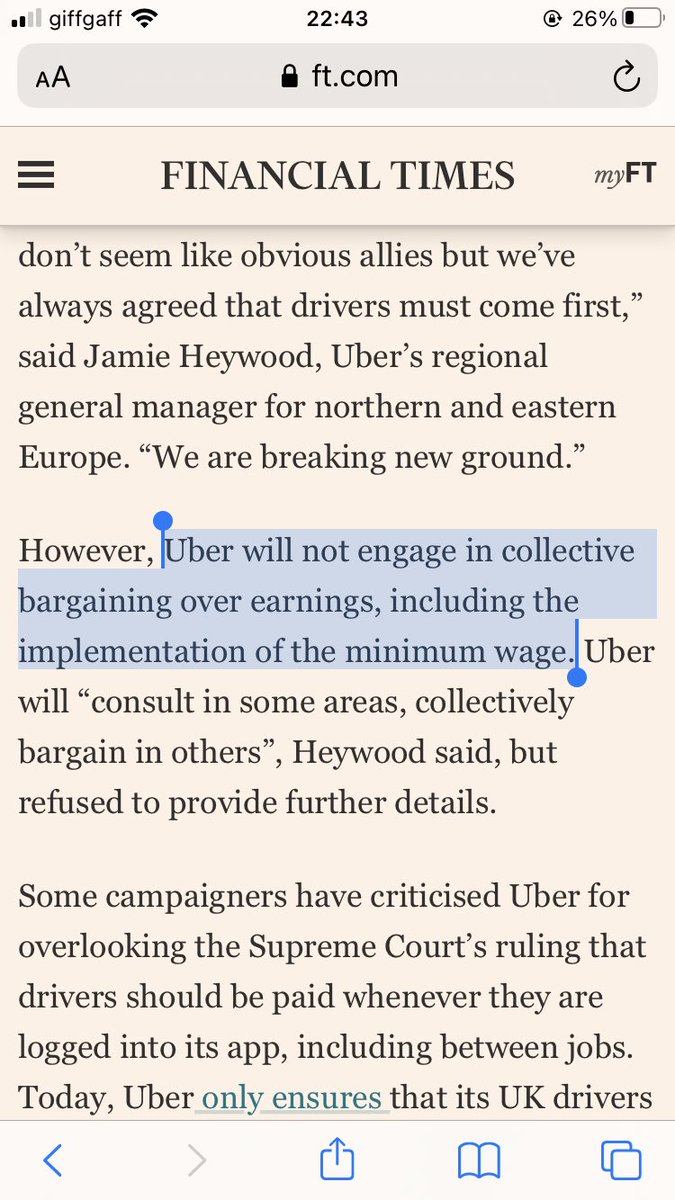
Unionisation like this is always a positive for the workers and I hope it brings about positive changes for all of Ubers drivers and leads to further unionisation efforts in the ride sharing market around the globe. If you're an uber driver in the UK get active and push for the improvements you need, and if you're an uber driver around the world start organising!